

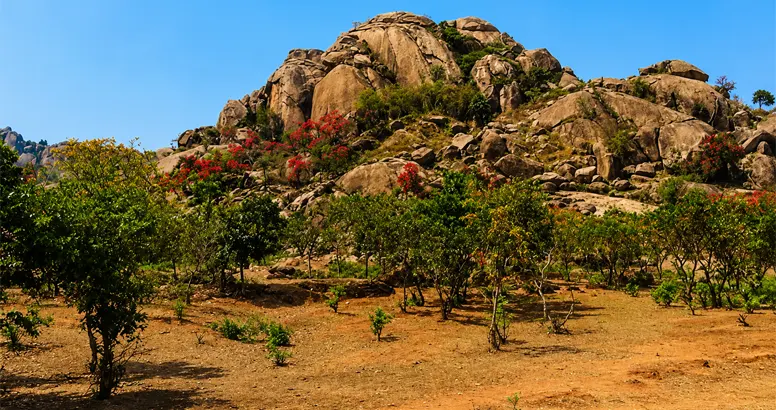
How far back can we trace the geological history of Jharkhand?
In Singhbhum, there are rocks that keep clues from events that happened over three billion years back. The Singhbhum Craton is not just known for minerals. It is a major piece of old crust in the Indian part of the subcontinent. For researchers, it is a chance to look at how continental crust formed, changed over time, and became stable early in Earth’s history.
What Is a Craton?
A craton is a very old part of the continental crust. It stays fairly stable for a long time. It also keeps its form through many later geologic events.
The Singhbhum Craton includes a mix of older rocks. There are granitic rocks, metamorphic rocks, volcanic rocks, and sedimentary rocks. These layers hold clues about what happened in the Precambrian.
You can see its role in a few key parts:
- First, there are ancient crystalline basement rocks.
- Next, the Singhbhum Granite and other granitoid rocks are present.
- There are also iron rich sequences of supracrustal rocks.
- Some of these units are Banded Iron Formations.
- The area also shows structurally complex belts.
- In addition, the Singhbhum Shear Zone and related mineralisation occur here.
Because of these elements, the region is useful for basic geology work. It is also important for finding mineral resources.
The Singhbhum Iron Ore Province
A key feature of the craton is how it links to the Singhbhum Iron Ore Province. In that area, there are wide stretches of iron-rich rocks. These rocks have played a major role in making Jharkhand a well known place for iron ore. Still, the value of these deposits is not only money.
The iron formations also tell a scientific story. They show what the land and environment were like when they formed. What they are made of, how the layers are set up, and how the structures relate to each other can let geologists rebuild older settings. In turn, this helps explain how Earth’s crust changed over time and how surface systems worked.
The Singhbhum Shear Zone
One standout landform in the region is the Singhbhum Shear Zone. It acts as a wide, strong structural strip. In reports tied to mineralisation, copper often draws the most attention.
Shear zones also have a second use. They can make paths for hot fluids moving in the crust. When the local rock setup fits, those fluids may leave behind minerals that later become valuable to mine.
For that reason, structural geology is a key part of mineral search work near Singhbhum.
Why Is the Singhbhum Craton Scientifically Important?
- The craton helps us look at some core problems.
- Why did the first continental crust get started?
- What changed ancient rocks through tectonics and metamorphism?
- What settings led to big mineral deposits?
- How did early volcanic layers and sedimentary systems develop over time?
- How did big structures affect mineral formation?
These topics matter for Jharkhand, but they also help explain how Earth worked in its early days.
Critical Thinking: Mineral Province or Geological Heritage?
Singhbhum Craton poses a tough problem for today’s geoscience work. The rocks here hold minerals with major economic value. At the same time, these rocks keep a record of Earth history that cannot be replaced. So a wider question comes up.
How can people use mineral wealth and still keep the ground’s geological story intact?
Because of this, exploration should not focus only on taking ores. Better mapping of the area matters. Recording key outcrops is also important. Research efforts and careful planning for mines can reduce the risk that development will erase the local geological heritage.
For the Society of Geo Scientists Jharkhand, Singhbhum is a key region. It is a good place to push geological study. It also supports sharing professional know-how. And it helps raise public attention to the geological heritage of Jharkhand.
Conclusion
The Singhbhum Craton links several big parts of geoscience: Earth history, mineral resources, and field study.
Old rocks there help people trace how continental crust formed. The main geological features also shed light on where mineral deposits formed. Even now, the rocks that are visible on the surface act like outdoor study sites for geoscientists.
So for Jharkhand, this craton is not only a place with minerals. It is also a record of past geology that matters for research. It can still help us learn about the ancient Earth and think about how to use resources in a careful way today.